Dissecting homework
WDAGHTLL (what does a good homework task look like?) Do we know? How often do we discuss homework tasks? Why is it worth doing?

There was a time when, if I asked whether teachers had ever received training on homework, almost no hands would go up. These days, more hands are raised.
But, even when training is offered, it is crucial to pause and really examine the homework being set. Is it purposeful? What does it actually achieve? Could it slip into busywork? And are there moments when teachers are exhausted or overwhelmed, when the quality of homework inevitably takes a hit?
In a previous post, I wrote about 5 mistakes we might make with homework. In this post, I will dissect four homework tasks by answering these questions:
What purpose does it serve?
Is there consistency in format and setting?
What feedback is provided? How is it provided?
How is it used to inform teaching?
Homework task 1:
What purpose does it serve?
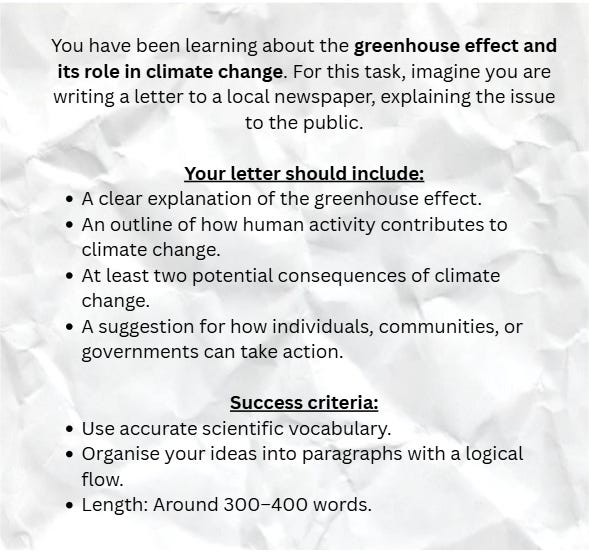
This homework recaps recent knowledge on the greenhouse effect. On the surface, it seems engaging, and students who like writing will find it an interesting piece to work on. Some might say that this task exposes students to a real-life scenario, giving them a chance to practise communicating science to a wider audience.
By focusing only on content taught in the most recent lessons, it misses the opportunity to build retrieval practice across wider areas of the specification. Students are not being asked to connect this topic to prior knowledge (such as energy resources), which means the task reinforces only surface-level recall rather than strengthening long-term memory.
Another concern is the ease with which this task could be outsourced. The format of writing a letter on a popular topic like climate change makes it particularly vulnerable to students relying on AI tools or simply copying generic examples from the internet. This undermines the purpose of the homework, since the teacher cannot be certain that the work reflects the student’s own understanding.
Is there consistency in format and setting?
There is no clear information about how frequently homework is set or what typical tasks look like. It is reasonable to assume, however, that writing a letter is not a routine task. In a recent conversation, a student shared that they found it difficult when homework wasn’t set on the same day each week, as it made planning and organisation a challenge. They explained that some days felt overwhelming with the volume of homework, while others were noticeably less so.
Of course, some might say that this style of homework should only be a one-off. But then I would suggest that changing the format and routine of the homework for this one-off task is not worth it. Students complete their homework away from our support and influence. Some struggle with sitting down to focus on a piece of homework. When that homework is in an unfamiliar format and style, it forces them to put aside some mental effort to work out what is expected of them.
What feedback is provided? How is it provided?
For a class of 25 students, a teacher would need to read at least 7,500 words. For me, that would take a minimum of 30 minutes to read and mark. On the surface, that might seem manageable, but most secondary teachers don’t just teach one class. This year, I teach 11 classes, with around 270 students in total. If I set and marked this kind of homework, I’d be facing over 81,000 words to read, process, and give feedback on. That’s hours of work!
One option might be to use peer assessment during the lesson. If time allows, this could have some benefit, since students would revisit content they had encountered a few lessons earlier. But what happens if not everyone completes their homework? Peer feedback can be inconsistent- some students take it seriously, while others are more relaxed.
And then there’s the bigger question: how exactly is this task being assessed? Is it judged on writing style? On whether students used key terms correctly?
How is it used to inform teaching?
Once the task is assessed, in whatever way that happens, what information does the teacher actually gain to inform future teaching? If I had just taught the greenhouse effect, this task might highlight some misconceptions about how the enhanced greenhouse effect contributes to climate change and its consequences. But I have to ask myself: is this really the best way to uncover those misconceptions?
As a science teacher, the style and persuasiveness of the letter does little to support my planning.
Homework task 2:
This is a Carousel Learning task. I use it to set all homework tasks and I think it is brilliant. This dissection serves to show how a teacher’s use of a well-designed resource can still be improved.
What purpose does it serve?
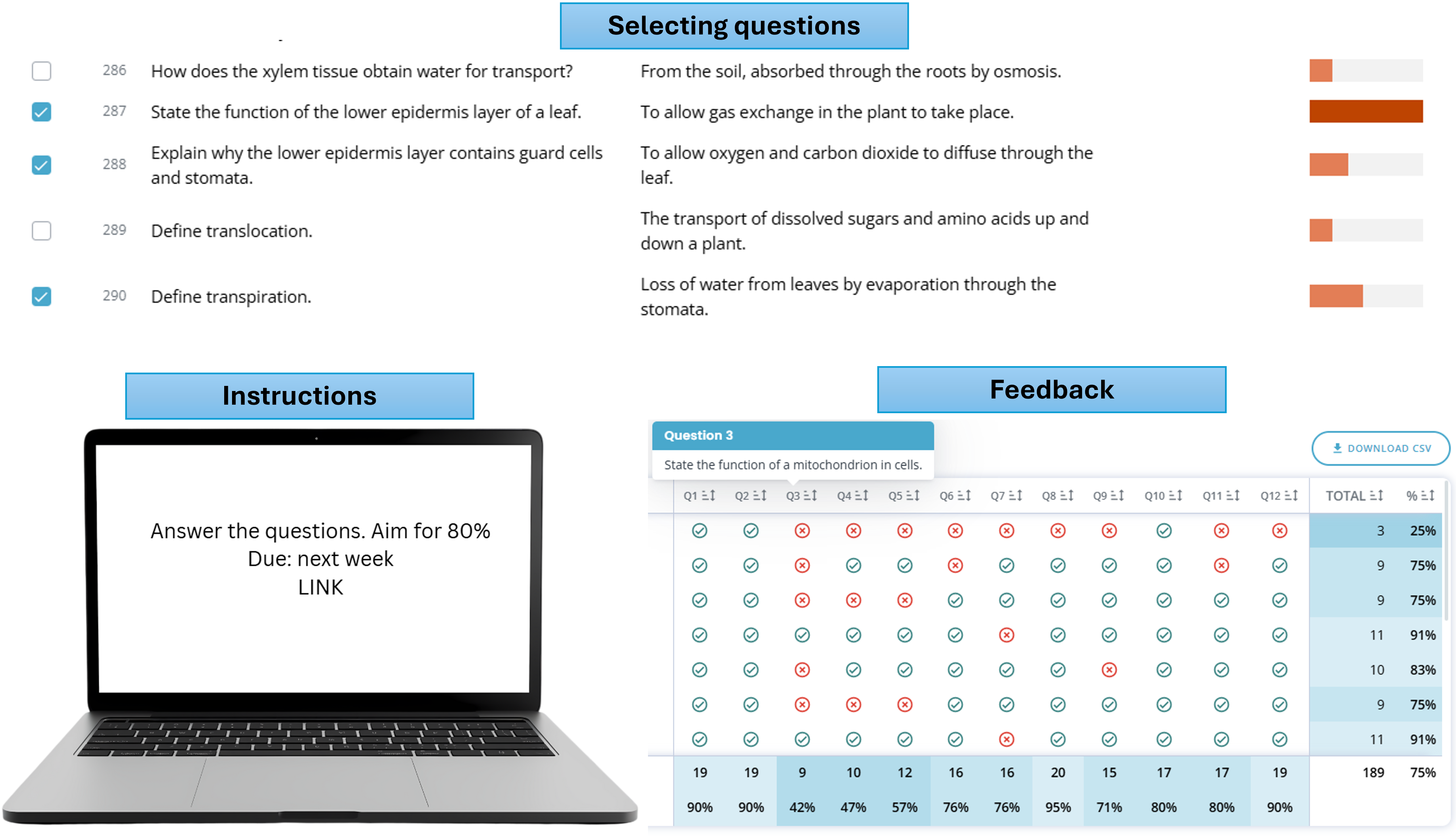
This homework takes the form of retrieval questions, which students complete after learning flashcards. When selecting questions, the teacher can use c-scores to identify both questions that have been asked less frequently and those that students have previously answered, but may benefit from revisiting. The quiz can include questions from multiple topics, giving students the opportunity to practise spaced retrieval and strengthen long-term memory.
Is there consistency in format and setting?
If Carousel is used routinely, it provides consistency in format and style, which can help students know what to expect and make planning easier. One potential drawback is that students would need to complete this homework on a device. In an age when monitoring and reducing screen time is important, assigning online homework could be seen as counter-productive. There is also the risk of distractions if students are using the device unsupervised.
On the other hand, many students are online anyway, so using digital platforms like Carousel allows them to learn in a controlled and purposeful way. It can also offer immediate feedback, and make it easier for teachers to incorporate retrieval practice or spaced revision.
It is important to consider the clarity of instructions in any homework task. In this example, the instructions are minimal, offering little guidance on how students should approach the work. There is no indication of whether they should learn the flashcards first or whether they are expected to attempt the quiz multiple times. The tone also feels impersonal and abrupt, which may make it harder for students to complete the homework effectively.
Compare those to the following instructions:
Click on the link
Type in your first and last name
Learn the flashcards for at least 10–15 minutes. Have you checked if you know them well?
Attempt the quiz, answering questions from memory
Learn the flashcards again on a different day
Retake the quiz to improve your score
These instructions are clearer, more structured, and feel more supportive. They include prompts that guide students through the process and encourage reflection, which can help them succeed. Clear instructions also reduce confusion and support independent learning.
What feedback is provided? How is it provided?
On Carousel, there is the option of using whole class feedback to give advice that is specific to the task rather than the student (see image below).

In this example task, it appears that this option has not been used. One possible reason is time constraints- teaching 11 different classes makes reviewing student responses very time-consuming, even if the homework is shorter than 300 words.
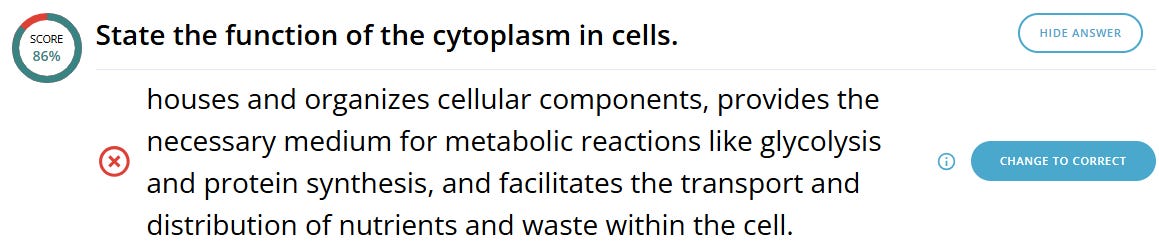
However, failing to read responses or provide any feedback can quickly undermine the purpose of the homework. Students may lose motivation to engage, and some may submit work that is clearly copied, as shown in the example below.
How is it used to inform teaching?
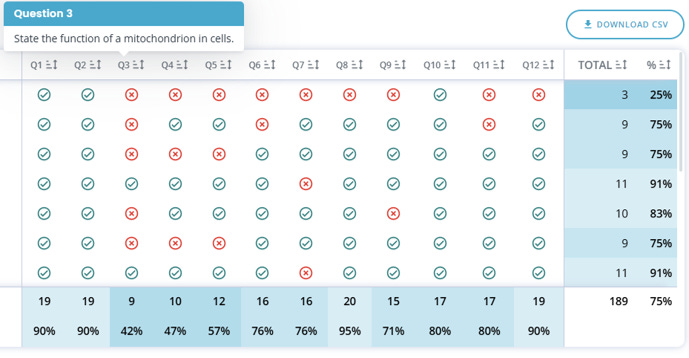
In this task, the teacher focused on a question that only 42% of the class answered correctly. By using this information to reteach the concept and pose the same question again in the future, the homework becomes a powerful tool. Students are given the opportunity to revisit and strengthen their retrieval of knowledge. Over time, consistently linking classroom teaching with independent practice like this can be a highly effective strategy for supporting long-term learning.
Homework task 3:
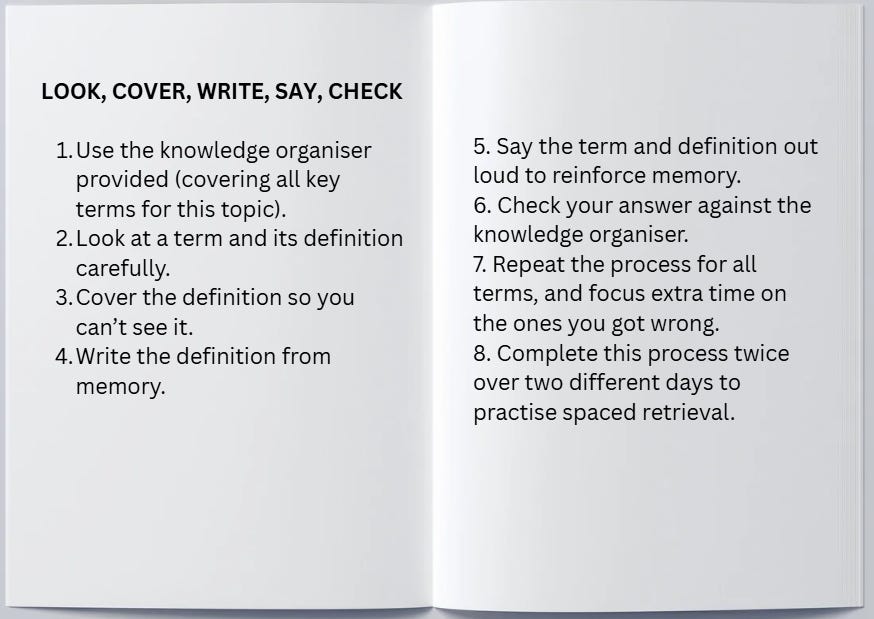
What purpose does it serve?
This homework is designed to help students strengthen their recall of key terms and definitions. By using Look, Cover, Write, Say, Check, students are actively retrieving knowledge rather than passively rereading notes or textbooks. Over time, completing tasks like this regularly encourages students to build stronger connections between concepts, making it easier to apply knowledge in lessons. The added benefit is it trains students in the basics of revision when it comes to assessments.
The effectiveness of this style of homework depends significantly on how well the student engages with it. Are they truly writing from memory, or simply copying the definitions? There is no way to know for certain whether a student has completed the task a number of times. Some might argue that this approach focuses mainly on surface-level recall and does not challenge students to engage with more complex questions or deeper thinking.
Is there consistency in format and setting?
The task is highly consistent in both format and expectations. The predictability helps focus cognitive load on the actual task, allowing students to focus entirely on retrieving and recalling information rather than trying to interpret instructions. The familiar routine also supports good study habits, giving students a structured way to revise independently, which is especially valuable for developing long-term learning skills.
What feedback is provided? How is it provided?
Feedback is immediate and built into the task itself. When students check their answers against the knowledge organiser, they can instantly identify mistakes. Students can also repeat the task on different days, using the results to focus on weaker terms, which supports spaced retrieval and promotes long-term retention.
How is it used to inform teaching?
In theory, this task provides teachers with useful information about which terms or concepts students find difficult, but only if it is checked. Without reviewing the completed work, teachers cannot identify misconceptions or gaps in understanding. However, checking multiple Look, Cover, Write, Say, Check responses across a whole class can be time-consuming and add significantly to teachers’ workload. One way this style of homework can be used powerfully is to pose some of the homework questions in class to show students how important they are and how they link to what is being learnt in the classroom.
Homework task 4:
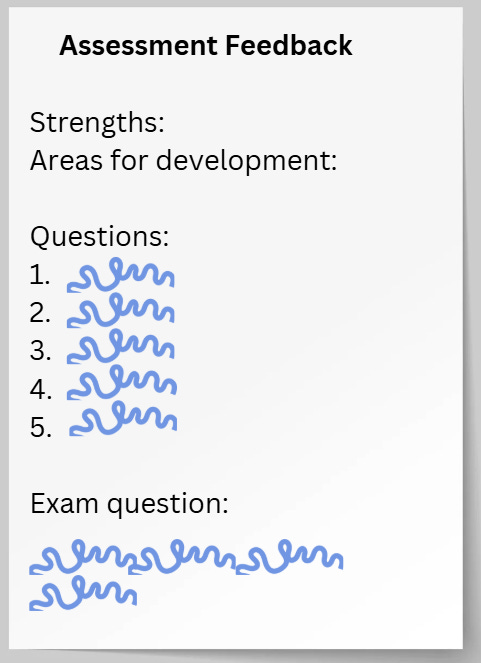
What purpose does it serve?
This homework allows students to revisit content they struggled with in a recent assessment. By working through questions similar to ones they previously got wrong, students practise retrieving knowledge from memory. Completing the feedback sheet also encourages reflection on learning.
But is it right to set it for homework? If the feedback is so important, it should ideally occur in the classroom, where teachers can be sure that students are engaging with it. At home, there is a risk that students may not complete it, attempt it much later so the feedback loses impact, or even copy answers.
Additionally, if this sheet is set for homework simply because there was not enough time in class, it supports the argument that key learning should take place during the school day rather than being shifted to independent homework. This is because the homework appears to be of the type where students complete work from lessons at home because the school day isn’t long enough.
Is there consistency in format and setting?
While the feedback sheet may be familiar if students have used it before, the homework itself is not consistently set, as it only follows an assessment. Unless assessments are given very regularly, students will not experience this type of homework frequently. The format of the sheet may be clear, and students who have completed it previously know what to expect, which helps reduce unnecessary cognitive load. However, because it is tied to the timing of assessments rather than a regular routine, the overall consistency of homework is limited, and it may not support the development of long-term study habits.
What feedback is provided? How is it provided?
The student has completed an assessment and received some feedback in lesson. Then they are given the feedback sheet to work on for homework. When will this feedback sheet be checked? Will it be self-assessed in the next lesson? How can the teacher ensure the valuable feedback from the assessment has landed if the task is set for homework?
How is it used to inform teaching?
Unless the teacher marks or checks these homework sheets, the actual task does not inform future teaching. The data from the assessment may still inform teaching, but the added value of the homework is lost if it is not analysed.
Why is any of this important?
Learning in the classroom rightly gets a lot of attention. However, if we are setting homework and not putting as much thought into it, then we are not setting up our students for success.
Changing our mindset towards long-term learning and not just lesson-by-lesson, will help us view homework as integral to the learning process.
Here’s the thing: homework can appear effective on the surface. When we examine the details of the tasks we set and the mechanics of the homework, we move closer to designing homework that truly integrates with classroom learning. School leaders should make it a priority to consider homework when focusing on teaching and learning. It is not extra work- it is part of the work!
For more on homework, do look at my book The Homework Conundrum.
Refreshing and practical - as always, Jo! Thank you